Saturday, January 07, 2012

thamel babu's tattoo

How to make a temporary tattoo:
A Temporary Tattoo is a non-permanent image on the skin resembling a real tattoo. Temporary tattoos can be drawn, painted, or airbrushed, as a form of body painting, but most of the time these tattoos are transferred to the skin. Temporary tattoos of any kind are used for numerous purposes including self-expression, identification, and advertising. For example, actors who wish to add to their character's distinctiveness might take temporary tattoos painted on the skin by hand or using stencils as part of their cosmetic ritual.
                   Temporary tattoos usually consist of five main elements: the front of the sheet of paper, the back of the sheet of paper, ink, glue and a protective plastic sheet. The front of the sheet is covered with a special coating upon which the tattoo image is printed with special inks. A layer of glue is then applied on top of the image. A thin, transparent plastic sheet is placed over the front of the sheet to protect the image and glue layer. The back of the sheet is left untreated and has a list of ingredients and instructions printed on it.
Transfer temporary tattoos are usually applied by removing the plastic sheet, placing the image face down against the skin and moistening the backing by wetting it thoroughly. The backing can then be carefully removed, leaving the image in place.
In 1980, temporary tattoos were created using different and exotic ink systems. 3M designed and developed a special coating called Micro-Fragrance that made scratch-n-sniff technology possible. The temporary tattoo industry adopted the scratch-n-sniff concept and a few companies, such as Dallas-based Highgate Products, released scented tattoos.
Around this time advances in ink and screen printing were also developed. These advances made the tattoos last longer and look more realistic. As tattoos quality increased, so did demand. People began seeing temporary tattoos as a product that could last and could be used outside of inexpensive giveaways.
Today, temporary tattoos are sold everywhere from vending machines to check-out counters at mass retailers to high-end boutiques and can be customized and printed through a color laser printer using specialty color laser transfer paper. A variety of tattoo designs exist; everything from Marvel superhero tattoos, to glitter designs, to Ed Hardy temporary tattoos for trendy adults and clubbing designs for young people.

Saturday, January 07, 2012

thamel babu's tattoo

About tattoo machine(gun)
A tattoo machine is a hand-held device generally used to create a Tattoo, a permanent marking of the skin with indelible ink. Modern tattoo machines use electromagnetic coils to move an armature bar up and down, Connected to said armature bar is a barred needle grouping that pushes ink into the skin. Tattoo artists generally use the term "machine", or even "iron", to refer to their equipment. The word "gun" is often used but is looked down upon by professional artists.
Rotary tattoo machine: A rotary tattoo machine, built in 1978 by Manfred Kohrs of Germany. Rotary tattoo machines were the original machines, based on rotary technology, which was invented by Samuel O'Reilly and improved by the tattoo artists through the years. Rotary type machines use an electric motor to drive the needles. Some recent upgrades include using an armature bar to increase efficiency, a characteristic of coil machines. Recently, there have been improvements to make this type of machine pneumatic, in place of the electric motor used now.
Coil tattoo machine: Coil tattoo machines are the most commonly seen and used. These machines use an electromagnetic circuit to move the needle grouping. There are many variations, from single-coiled machines to triple-coiled machines. They can be made from many different materials and in many different sizes and shapes. Dual-coiled machines are considered to be standard. The coils generally range from 8 to 10 wrap. The coils create the ohms,or resistance, used to properly regulate the machines speed and power. Causing less trauma to the skin.
Liner tattoo machine: The purpose of a liner machine is to lay the ink in the skin in one single pass to create a dominant line. It uses a short contact circuit (about 1.5mm–2mm), which causes the machine to cycle faster.
• Shader tattoo machine: The shader machine is commonly used to shade black or variants of black ink. Also Color is used in this type of machine, the saturation level of this machine is low. It uses a bigger contact gap than a liner (about 2mm–3.5mm) to make it cycle slightly slower. This machine is also used for sculpting lines. Some artists will use this type of machine for all lines, as it allows the lines to be retraced with less trauma to the skin.
Pneumatic tattoo machine: Tattoo artist Carson Hill in the year 2000 invented the first pneumatic tattoo machine and began the patent process. A pneumatic tattoo machine is powered by an air compressor, and they are extremely lightweight. Pneumatic tattoo machines use pressurized air to power the tattoo machine and drive the needles up and down. These tattoo machines are entirely autoclavable, so that the entire tattoo machine can be placed in the autoclave and sterilized fully without any major disassembly. Unlike traditional coil machines, which require complete disassembely to be placed into an autoclave.
Tattoo machines are not limited to just these types. A common variant is having a "cutback", which uses stiffer front springs. This is more commonly used in liners, but is known to be used on shader machines, more typically for portrait work. Machines are usually categorized into long stroke and short stroke varieties. The longer-stroked machines are good for coloring and shading, as well as sculpting lines, while doing less damage to clients' skin. Shorter-stroke machines are commonly used for lining in a single pass style, and also in a shader setup to achieve a more subtle gradation of black such as would be found in portraits. Length, width, tension, angle, and stiffness of the spring varies the functionality of the machine. The contact gaps, as well as capacitor's and even the style of machine and its angles of deflection, can also all be variants in machine tuning. The proper tuning of the machine is essential for the type of machine being used, also for the type of tattoo the artist is doing.

Saturday, January 07, 2012

thamel babu's tattoo

        Tattoo is an art of making design in the body of people with a needle piercing through the skin into the middle layer above the meat and below the skin.A tattoo is made by inserting indelible ink into the dermis layer of the skin to change the pigment. Tattoos on humans are a type of body modification and tattoos on other animals are most commonly used for identification purposes. The first written reference to the word, "tattoo" (or Samoan "Tatau") appears in the journal of Joseph Banks, the naturalist aboard captain crook's ship the  in 1769: .Tattooing has been practiced for centuries in many cultures spread throughout the world. The Ainu, the indigenous people of Japan, traditionally had facial tattoos. Today one can find Moari of New zeland, Hausa people of Northern Nigeria, Arabic people in East-Turkey and Taiwan with facial tattoos. Tattooing was widespread among Polysian peoples and among certain tribal groups in the Africa, North America, South America, Europe, Japan, New Zealand. Indeed, the island of Great britain takes its name from tattooing, with Britons translating as 'people of the designs' and the Picts, who originally inhabited the northern part of Britain, literally meaning 'the painted people'.Britsh people remain the most tattooed in Europe Despite some taboos surrounding tattooing, the art continues to be popular in many parts of the world. 
     It is located in thamel, bhagawan bahal, kathmandu.It is runed by Prashanna Pradhan who is 18 years old and lives in thamel.Firstly it was runed by Babu Raja Pradhan.he was the first tattoo artist of Nepal.beside Thamel babu's tattoo there are many tattoo studio opened in nepal.Thamel babus tattoo was the first tattoo stuidio of Nepal which was first opened around 1994 A.D. then Babu Raja pradhan  was the one and only  artist at that time, after that many studio opened one by one many tattoo studio was opened and recently there are almost 25 tattoo studio only in Thamel area and alround nepal there are about 60 newly opened.


Tuesday, July 26, 2011


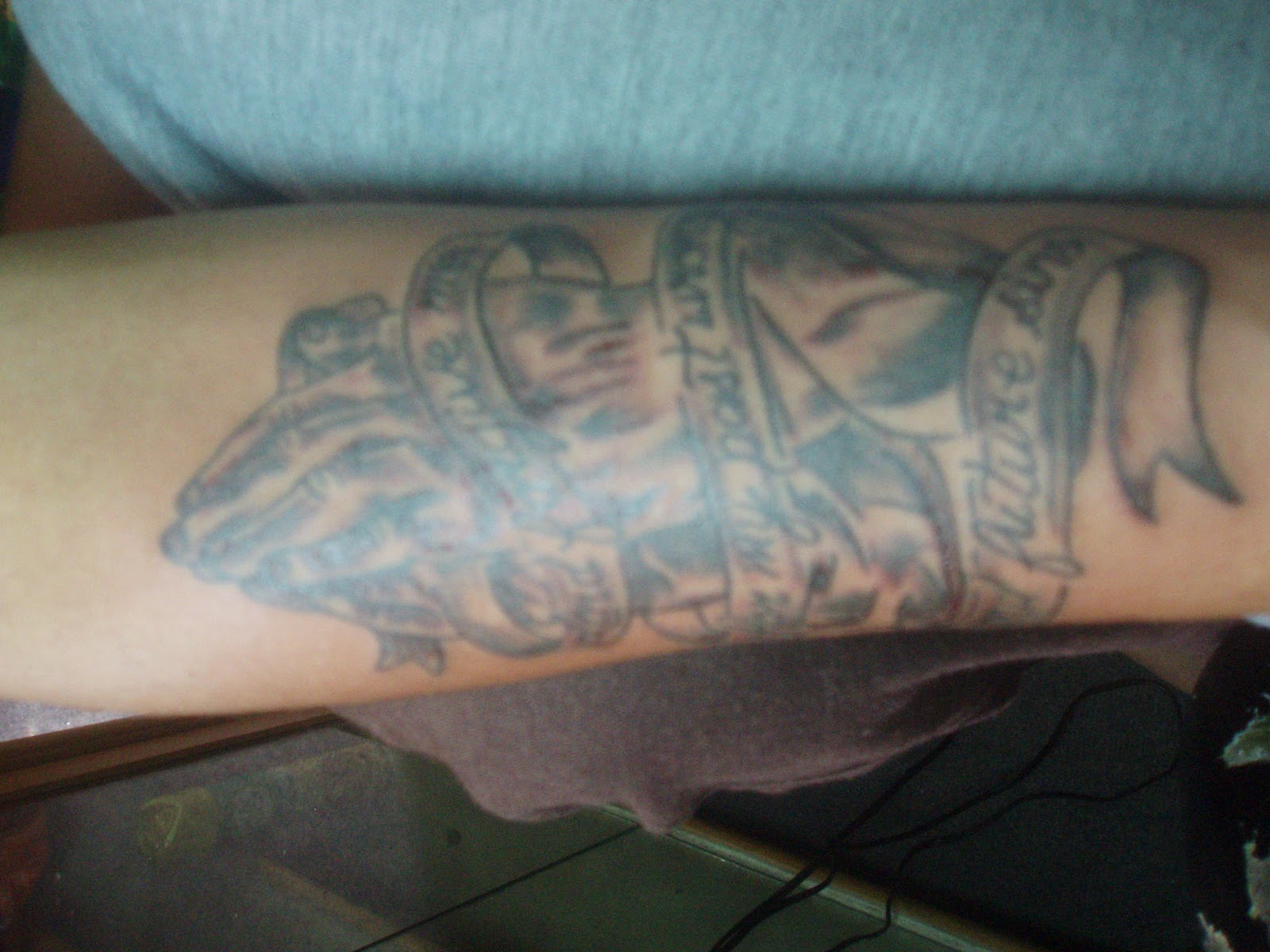
This tattoo on me represents the respect & love i hav in for my mom n my (late)dad.i love them so much. I miss u so much dad, i miss him in all the moments in my life. This tattoo symbolizes me that he is in me n supporting me in each n every step of my lifen motivates me for moving forward. Thank you dad wht u hav done 4 me.Miss u a lot 

Thursday, July 14, 2011

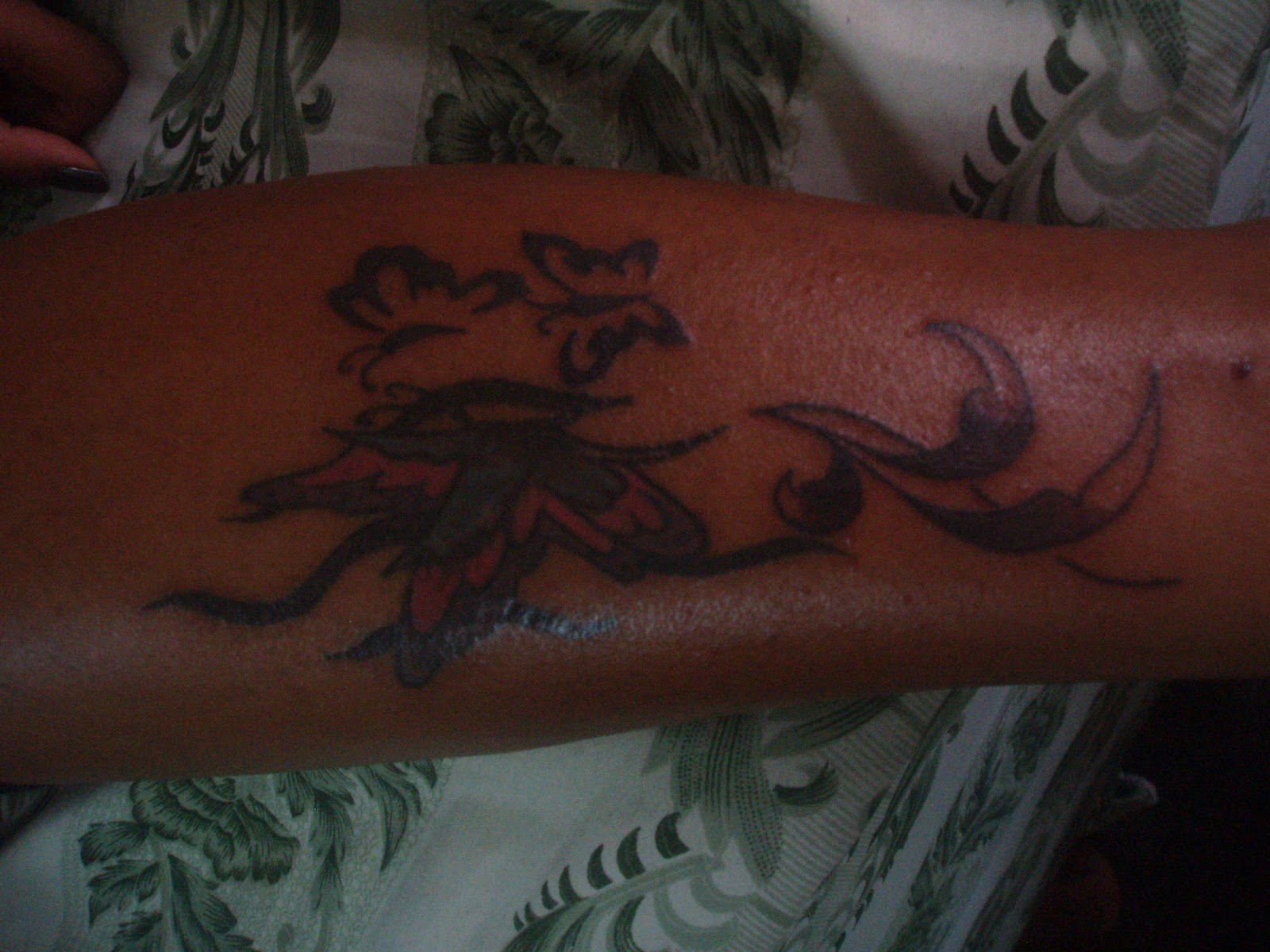
My recent work


“It will make me different from the others and give me added confidence,” informs Shearie.Indeed the tattoo has become an international fashion statement of the young generation.

Yet tattoos have an ancient history. Scientists unearthed an iceman in the Alps with tattoos that dated back over 5000 years. Similarly Egyptian mummies were believed to have tattoos. The art of tattooing was introduced to China around the year 2000 BC. Greek spies used tattoos to communicate among themselves, while the Romans tattooed their criminals.

Traditions of tattoos in Nepal
In Nepal traditional tattoos have been popular for many generations, especially among the Newari and Tharu communities. The Newar communities of the Kathmandu Valley, especially those of Tebhal and Thimi in Bhaktapur, may be the first to have used tattoos in this country. Among the Newari community tattoos are commonly known as ‘lha–chyogu’. ‘Lha’ means ‘flesh’ and ‘chyogu’ means ‘writing’, thus ‘writing on the flesh’. Tattoos are most commonly used by women and lower-caste Newaris. The tattoos on the feet of Newari women from the Bhaktapur-Thimi area symbolize strength and are supposed to be attractive to the men folk. Skill-oriented classes such as carpenters, potters, barbers and farmers are inclined towards this art. Newaris have a traditional belief that tattoos on one’s body drive away misfortunes. Another belief among the older generation is that when a man dies he takes nothing from this world with him except the tattoos on his body. On the way to heaven if this man comes up against hardships he can sell the tattoos and thus make his way to heaven more comfortable. Tattoos are also used for protection in this life; children are tattooed at an early age to protect them from illness and other scourges of evil spirits. Tattoos often have religious significance; Newari elders have tattoos with images and symbols of different gods and goddesses. The concept of reincarnation is also linked with tattoos. Various religious scripts say that a reincarnated individual will have a sign of their previous life or divinity, for which purpose a tattoo may serve well. This idea is reflected among Hindu Nepalis wearing tattoos on the hands, mostly symbolizing incarnations of the gods such as Shiva, Vishnu, Ram and Krishna, or an Om. (The term for tattoo in Nepali is khoot lagaunu.) These tattoos are common on individuals 40 years of age or older, but have not been used as much in recent decades.

The Tharus are another community well acquainted with the art of tattooing. In Tharu language the tattoo is known as ‘godhani’. Tattoos are predominant among women of the Tharu community and are applied before marriage all over the body, depicting mostly mythological stories and historical events. In this community a newborn child is tattooed either on his leg, hand or chest with designs mostly of birds. These tattoos are done following detailed rituals in the Tharu tradition. The religious value of tattooing a newborn child in the Tharu community is similar to that of bhartabandha, the sacred thread ceremony among Hindus. It is a belief among the Tharus that those with tattoos designed on their bodies will find a place in heaven. Though the tradition of tattooing has lost some of its importance in this generation, tattoos are still common among Tharu elders.

The people of the high mountainous regions also took to tattooing. Here in the absence of modern equipment tattooing is traditionally done with the help of a ‘nilkadha’ (the thorn from the nil tree). The nilkhada is dipped in goat’s milk and designs are made mostly on the hands, cheeks chin, legs and the forehead.

Contemporary Tattoo Art
As the traditional forms of tattooing have declined, a new generation of tattoo lovers have sprung up. Tattoo as an art in Nepal has been kept alive by the efforts of Babu Raja Pradhan a professional tattoo artist who resides in Thamel. Though there is a vast difference between the tattoos of ancient Nepal and most of those designed by Babu Raja Pradhan, still his efforts to preserve and give continuity to this form of art cannot be ignored.

When he started tattooing as a profession back in 1991, Babu Raja was not sure that tattoos would gain popularity in Nepali society. Tired of his job as a driver, he was attracted to the art of tattooing. A visitor from Austria helped Babu Raja turn his enthusiasm into a profession. Gradually he learned the art of designing tattoos, eventually becoming the most recognized tattoo artist in Nepal. Babu Raja feels that tattooing is a personal choice that is not in any way vulgar or unnatural. “Tat toos in Nepal are mostly confined to the younger generation of males, though young women also sometimes come for them,” says Babu Raja. Babu Raja uses a huge variety of designs from many sources, including a few traditional Nepali designs.

“Nepal has a big market for tattooing. Besides the tourists and the common folk who come to design tattoos, even members of the royal family in Nepal have had them. The late Dhirendra Shah and his brother in law Rajiv Shahi both had tattoos done by me,” says Babu Raja. Tattooing on the arms is common among young men while the young women like to get their hips tattooed. Young people I came across in Thamel with tattoos had different reasons for tattooing themselves. Renu, an eleventh standard sutdent said that the butterfly tattooed on her back gave her the feeling of being free and independent. Sameer had another tale to tell: “I had my girlfriend’s face tattooed on my back when we were head over heels for each other, but now she has left me and the tattoo is all I have with me.” Norden, a physically strong young chap from Sikkim, has his arms tattooed with pictures of dragons and knives, which he says make him feel strong and manly. And there were those who claimed that having tattoos on their body made them feel intelligent!

How it’s done

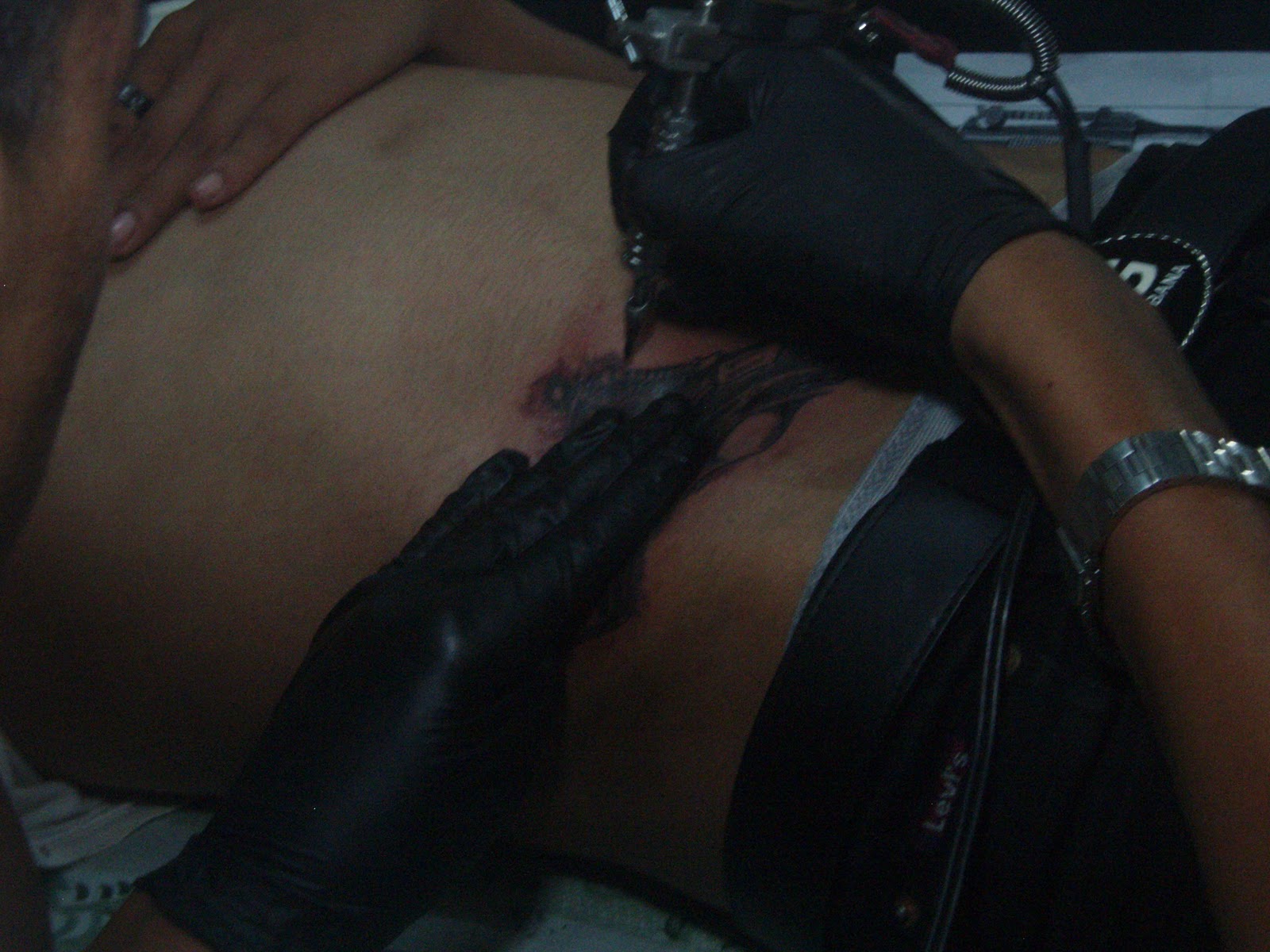
Tattooing is a painstaking art both for the artists and the customer. After shaving and disinfecting the skin the tattoo artist makes a stencil transfer of the design the customer has chosen. The tattoo gun is like a sewing machine and the flesh becomes the fabric. A bar of up to 18 needles bobs up and down injecting ink into the skin’s middle layer. For a three-inch design, the tattooing gun whirs for at least twenty minutes. It feels like a bee sting for the entire time. One should not leave a tattoo parlour immediately, to make sure there is no adverse reaction. Tattoos are wounds that take time to heal. Swelling of the skin and some crusting and peeling are common for the first few weeks. It is not wise to go for a swim or soak in hot water while the tattoo is healing. However, in terms of safety and health, tattoos are not considered harmful for the body (some even believe that tattoos are helpful for resisting certain illnesses, perhaps a holdover from traditional Nepali ideas). “Tattooing does not affect the skin in any way. Tattoos can be removed with the help of lasers or surgery,” informs Dr. Helina Badal, a skin specialist at the Nepal-Korea Donsangh Skin Diagnosis Centre in Kathmandu .
Tattoo is indeed a challenging and daring art to adopt. In Nepal the cost of having a tattoo applied starts from Rs. 1000 and goes up from there. Getting rid of a tattoo is equally as painstaking as getting one done, and is often more expensive, requiring either laser or conventional surgery.

Total Pageviews