Wednesday, January 11, 2012

car insurance comparison sites

Nowadays cars are being bought and sold every day. as cars are bought and sold, accident are also happening in a daily basis. To minimize your expences in maintain your car it is easy you do car insurance.You can have car insurance in any sites. But the best one to get your car insuranced from following site:

http://www.ecarinsurancecomparison.co.uk/sites/

So get your car insurance and be in profit 

Saturday, January 07, 2012

thamel babu's tattoo

                                                         Some tattooing tips
#1: Do not mix different brands of tattoo ink. Tattoo inks have very different bases. Some water, some plant extract, some alcohol. Only like bases should be mixed. The best way to make sure you dont mix bases is by buying the colors you need, or by only mixing same brand inks. Tattoo ink consists of a pigment and a carrier. The quality of the tattoo you create can only be as good as the ink you use, so dont under estimate the importance of quality tattoo ink.
 
#2: Needles labeled as RL are round liners. These needles are for outlining and script. Round liners are also used to fill in tips on tribal pieces, with sharp points, once the outline is complete.
 
#3: Needles labeled as RS are round shaders. These needles are for creating blended areas of color, such as shadows, and depth. Round Shaders are great for fading color in and out of a background.
 
#4: Needles labeled as M, M1, M2 or Mag are Magnum. These needles are used when filling in large areas of solid color or for some shading. Magnums are great to use on large solid pieces of tribal. Magnums require a more experienced hand then your round liner and shader. M1 are pulled farther apart than the M2. An M1 is like a shader. The M1 is good when wanting a large area filled with color that fades out to another color or to cover a large area fast. The M2 is great when wanting an area of solid color that comes to a crisp line with no fading or variation in hugh or color. An M2 is like a liner, the needles are pulled together real tight (these wont work with normat flat tube numbers).
 
#5: Hold your machine at a 45 degree angle to skin when tattooing. You are inserting ink under the skin, if you put it in without the propper angle you will either release the ink (holding it to straight) or have fuzzy lines (to much of an angle).
 
#6: Keep records of all your clients as well as pics of all your work. If you are serious about working in a shop these records are just as important as a good portfolio. These records not only can release you from liability, but also show future employers that you have a following which means $$$.
 
#7: Practice on practice skin. Do not tattoo people until you and other people are certain that your tattoos are worthy of living tissue.
#8: Gray Wash Shading: To shade using gray wash tattoo ink first set 4 ink caps up in a row and fill the first one all the way with your Kuro Sumi gray wash tattoo ink, fill the 2nd 3/4 of the way, the 3rd 1/2 of the way and the 4th 1/4 of the way. Fill the partialy full ink caps the rest of the way with water. Fill one large ink cap all the way with water. Now that you have 4 different intensities of gray/black ink you can begin the shading process. Rinse your machine in the large water ink cap when moving from a lighter shade to a darker shade. (kind of like washing out your paint brush when painting). You can do this same technique with outlining ink if you use three times less ink to water.

#9:
When outlining, your needle should penetrate the skin about a millimeter. This is about as wide as a quarter.

#10: When shading, your needle should penetrate the skin about half of a millimeter. This is about the width of a dime.

#11: Proper depth control (tip#9 and tip#10) can mean the difference between a beautiful tattoo and a horrible catastrophy that can never be repaired. Measure depth at the tip. When done properly you will not see the needle unless the machine is running, and then just a millimeter or less. This way you wont be able to go to deep. (when you are dealing in millimeters, you can't trust your hand to control the depth, its just not possible.)

#12: Color: Tattoo color should be layed down in a certain order to avoid bleeding into the next color. Dark purple, Blues, greens, light purple, browns, reds, oranges, yellow, white.

 
#13: Piviot palm place ment: Make sure to keep a contact with the hand that is holding the tattoo machine on the persons skin that you are tattooing. This will provide stability and give you a pivot point when making a curved line. The machine hand needs to maintain this contact or you will get lines that are not crisp or consistent.
 
#14: The 5 "Ps": I have already listed these in the previous tips, but they cant be gone over two much, so here they are again. Propper Setup, Propper angle (tip #5), Propper depth contol (tip #9, 10, 11), Palm Placement(tip #13), and Practice Practice Practice (tip #7). If you are consistent about these basic tattoo priciples then you are on the right track to a successful career as a tattoo artist.
 
#15: Wearing gloves and using disposable tips, tubes, and needles will help reduce the spread of diseases like hepatitis. (avoid steel tips if you dont have a state approved auto clave device. Dispoabale tips are much safer , easier to use and save time). We will include disposable tips for free when you purchase 20 or more needles.

Saturday, January 07, 2012

thamel babu's tattoo

Body piercing is included in Thamel babu's tattoo:
Body piercing, a form of body modification, is the practice of puncturing or cutting a part of the human body, The reasons for piercing or not piercing are varied. Some people pierce for religious or spiritual reasons, while others pierce for self-expression, for aesthetic value, for sexual pleasure, to conform to their culture or to rebel against it. Some forms of piercing remain controversial, particularly when applied to youth. The display or placement of piercings have been restricted by schools, employers and religious groups. In spite of the controversy, some people have practiced extreme forms of body piercing, with Guiness bestowing World recos on individuals with hundreds and even thousands of permanent and temporary piercings.
Contemporary body piercing practices emphasize the use of safe body piercing materials, frequently utilizing specialized tools developed for the purpose. Body piercing is an invasive procedure with some risks, including allergic reaction, infection, excessive scarring and unanticipated physical injuries, but such precautions as sanitary piercing procedures and careful aftercare are emphasized to minimize the likelihood of encountering serious problems. The healing time required for a body piercing may vary widely according to placement, from as little as a month for some genital piercings to as much as two full years for the navel.
                                                                            History
Body adornment has only recently become a subject of serious scholarly research by archaeologists, who have been hampered in studying body piercing by a sparsity of primary sources. Early records rarely discussed the use of piercings or their meaning, and while jewellery is common among grave goods, the deterioration of the flesh that it once adorned makes it difficult to discern how the jewellery may have been used. Also, the modern record has been infiltrated with the 20th century inventions of piercing enthusiast. In the 1960s and 1970s, Malloy marketed contemporary body piercing by giving it the patina of history. His pamphlet Body & Genital Piercing in Brief included such commonly reproduced urban legends as the notion that  invented the piercing that shares his name in order to tame the appearance of his large penis in tight trousers and that Roman  centurions attached their capes to nipple piercings. Some of Malloy's myths are reprinted as fact in subsequently published histories of piercing.

Saturday, January 07, 2012

thamel babu's tattoo

How to make a temporary tattoo:
A Temporary Tattoo is a non-permanent image on the skin resembling a real tattoo. Temporary tattoos can be drawn, painted, or airbrushed, as a form of body painting, but most of the time these tattoos are transferred to the skin. Temporary tattoos of any kind are used for numerous purposes including self-expression, identification, and advertising. For example, actors who wish to add to their character's distinctiveness might take temporary tattoos painted on the skin by hand or using stencils as part of their cosmetic ritual.
                   Temporary tattoos usually consist of five main elements: the front of the sheet of paper, the back of the sheet of paper, ink, glue and a protective plastic sheet. The front of the sheet is covered with a special coating upon which the tattoo image is printed with special inks. A layer of glue is then applied on top of the image. A thin, transparent plastic sheet is placed over the front of the sheet to protect the image and glue layer. The back of the sheet is left untreated and has a list of ingredients and instructions printed on it.
Transfer temporary tattoos are usually applied by removing the plastic sheet, placing the image face down against the skin and moistening the backing by wetting it thoroughly. The backing can then be carefully removed, leaving the image in place.
In 1980, temporary tattoos were created using different and exotic ink systems. 3M designed and developed a special coating called Micro-Fragrance that made scratch-n-sniff technology possible. The temporary tattoo industry adopted the scratch-n-sniff concept and a few companies, such as Dallas-based Highgate Products, released scented tattoos.
Around this time advances in ink and screen printing were also developed. These advances made the tattoos last longer and look more realistic. As tattoos quality increased, so did demand. People began seeing temporary tattoos as a product that could last and could be used outside of inexpensive giveaways.
Today, temporary tattoos are sold everywhere from vending machines to check-out counters at mass retailers to high-end boutiques and can be customized and printed through a color laser printer using specialty color laser transfer paper. A variety of tattoo designs exist; everything from Marvel superhero tattoos, to glitter designs, to Ed Hardy temporary tattoos for trendy adults and clubbing designs for young people.

Saturday, January 07, 2012

thamel babu's tattoo

About tattoo machine(gun)
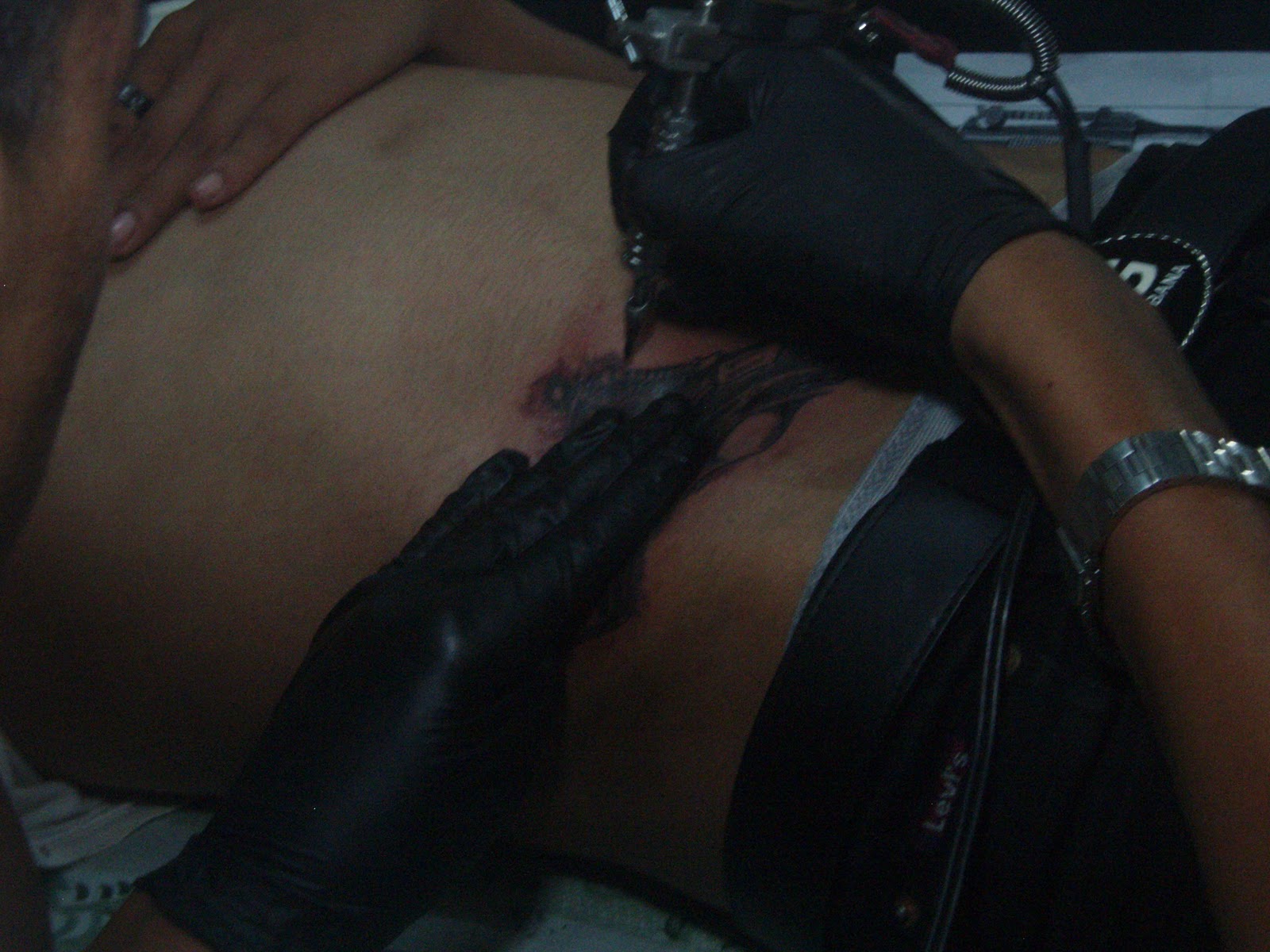
A tattoo machine is a hand-held device generally used to create a Tattoo, a permanent marking of the skin with indelible ink. Modern tattoo machines use electromagnetic coils to move an armature bar up and down, Connected to said armature bar is a barred needle grouping that pushes ink into the skin. Tattoo artists generally use the term "machine", or even "iron", to refer to their equipment. The word "gun" is often used but is looked down upon by professional artists.
Rotary tattoo machine: A rotary tattoo machine, built in 1978 by Manfred Kohrs of Germany. Rotary tattoo machines were the original machines, based on rotary technology, which was invented by Samuel O'Reilly and improved by the tattoo artists through the years. Rotary type machines use an electric motor to drive the needles. Some recent upgrades include using an armature bar to increase efficiency, a characteristic of coil machines. Recently, there have been improvements to make this type of machine pneumatic, in place of the electric motor used now.
Coil tattoo machine: Coil tattoo machines are the most commonly seen and used. These machines use an electromagnetic circuit to move the needle grouping. There are many variations, from single-coiled machines to triple-coiled machines. They can be made from many different materials and in many different sizes and shapes. Dual-coiled machines are considered to be standard. The coils generally range from 8 to 10 wrap. The coils create the ohms,or resistance, used to properly regulate the machines speed and power. Causing less trauma to the skin.
Liner tattoo machine: The purpose of a liner machine is to lay the ink in the skin in one single pass to create a dominant line. It uses a short contact circuit (about 1.5mm–2mm), which causes the machine to cycle faster.
• Shader tattoo machine: The shader machine is commonly used to shade black or variants of black ink. Also Color is used in this type of machine, the saturation level of this machine is low. It uses a bigger contact gap than a liner (about 2mm–3.5mm) to make it cycle slightly slower. This machine is also used for sculpting lines. Some artists will use this type of machine for all lines, as it allows the lines to be retraced with less trauma to the skin.
Pneumatic tattoo machine: Tattoo artist Carson Hill in the year 2000 invented the first pneumatic tattoo machine and began the patent process. A pneumatic tattoo machine is powered by an air compressor, and they are extremely lightweight. Pneumatic tattoo machines use pressurized air to power the tattoo machine and drive the needles up and down. These tattoo machines are entirely autoclavable, so that the entire tattoo machine can be placed in the autoclave and sterilized fully without any major disassembly. Unlike traditional coil machines, which require complete disassembely to be placed into an autoclave.
Tattoo machines are not limited to just these types. A common variant is having a "cutback", which uses stiffer front springs. This is more commonly used in liners, but is known to be used on shader machines, more typically for portrait work. Machines are usually categorized into long stroke and short stroke varieties. The longer-stroked machines are good for coloring and shading, as well as sculpting lines, while doing less damage to clients' skin. Shorter-stroke machines are commonly used for lining in a single pass style, and also in a shader setup to achieve a more subtle gradation of black such as would be found in portraits. Length, width, tension, angle, and stiffness of the spring varies the functionality of the machine. The contact gaps, as well as capacitor's and even the style of machine and its angles of deflection, can also all be variants in machine tuning. The proper tuning of the machine is essential for the type of machine being used, also for the type of tattoo the artist is doing.

Saturday, January 07, 2012

thamel babu's tattoo

        Tattoo is an art of making design in the body of people with a needle piercing through the skin into the middle layer above the meat and below the skin.A tattoo is made by inserting indelible ink into the dermis layer of the skin to change the pigment. Tattoos on humans are a type of body modification and tattoos on other animals are most commonly used for identification purposes. The first written reference to the word, "tattoo" (or Samoan "Tatau") appears in the journal of Joseph Banks, the naturalist aboard captain crook's ship the  in 1769: .Tattooing has been practiced for centuries in many cultures spread throughout the world. The Ainu, the indigenous people of Japan, traditionally had facial tattoos. Today one can find Moari of New zeland, Hausa people of Northern Nigeria, Arabic people in East-Turkey and Taiwan with facial tattoos. Tattooing was widespread among Polysian peoples and among certain tribal groups in the Africa, North America, South America, Europe, Japan, New Zealand. Indeed, the island of Great britain takes its name from tattooing, with Britons translating as 'people of the designs' and the Picts, who originally inhabited the northern part of Britain, literally meaning 'the painted people'.Britsh people remain the most tattooed in Europe Despite some taboos surrounding tattooing, the art continues to be popular in many parts of the world. 
     It is located in thamel, bhagawan bahal, kathmandu.It is runed by Prashanna Pradhan who is 18 years old and lives in thamel.Firstly it was runed by Babu Raja Pradhan.he was the first tattoo artist of Nepal.beside Thamel babu's tattoo there are many tattoo studio opened in nepal.Thamel babus tattoo was the first tattoo stuidio of Nepal which was first opened around 1994 A.D. then Babu Raja pradhan  was the one and only  artist at that time, after that many studio opened one by one many tattoo studio was opened and recently there are almost 25 tattoo studio only in Thamel area and alround nepal there are about 60 newly opened.


Total Pageviews